
The healthcare industry has evolved dramatically over the last few decades, particularly in how patient information is stored and managed. Two primary methods dominate this domain: digital hospital records (commonly known as electronic health records, or EHRs) and traditional paper records. Each method has its strengths and weaknesses, making it essential for healthcare providers to weigh their options carefully. This blog delves into the pros and cons of both systems and provides insights into which method might suit modern healthcare needs better.
Understanding Digital Hospital Records and Traditional Paper Records
Digital Hospital Records (EHRs) are electronic systems used to store, manage, and retrieve patient information. They include a comprehensive history of a patient’s medical journey, from test results and prescriptions to diagnosis and treatment plans. These records are stored in secure databases and can be accessed by authorized personnel from virtually anywhere.
Traditional paper records, on the other hand, involve physical files that contain a patient’s medical history. These files are often stored in filing cabinets, requiring manual handling and organization.
Advantages of Digital Hospital Records
- Enhanced Accessibility and Efficiency
EHRs allow instant access to patient data, eliminating the need to search through stacks of files. Physicians can pull up critical information in seconds, enabling faster decision-making and improved patient care. - Improved Coordination
Digital records foster better collaboration between healthcare providers. For example, a specialist can access a patient’s history shared by a general practitioner, ensuring consistency in care and avoiding redundant tests or treatments. - Data Security and Backup
While data breaches are a concern, most EHR systems come equipped with advanced encryption and multi-factor authentication. They also include automatic backup features, ensuring data is not lost due to natural disasters or human errors. - Analytics and Reporting
Digital records allow hospitals to analyze trends, identify patient patterns, and improve operations. This is crucial for preventive care, resource allocation, and performance benchmarking. - Eco-Friendly Alternative
Transitioning to digital reduces the need for paper, ink, and storage space, contributing to a more sustainable environment. - Compliance with Legal Standards
Many countries now mandate EHRs to meet healthcare compliance regulations, such as HIPAA in the United States or GDPR in Europe. Digital systems make it easier to adhere to these standards.
Challenges of Digital Hospital Records
- High Initial Costs
Implementing an EHR system requires significant investment in hardware, software, and staff training. Smaller healthcare facilities may find it challenging to bear these costs. - Technical Issues and Downtime
System crashes, slow networks, and technical glitches can disrupt operations. Hospitals need reliable IT support to mitigate these risks. - Learning Curve for Staff
Not all healthcare professionals are tech-savvy, and transitioning to a digital system may require extensive training and adaptation time. - Privacy Concerns
Despite security measures, data breaches remain a risk. Cybersecurity threats targeting healthcare organizations have risen in recent years, highlighting the need for constant vigilance.
Advantages of Traditional Paper Records
- Simplicity and Familiarity
Paper records are straightforward to use and don’t require technical training. Healthcare providers, especially in older generations, may prefer this method due to its familiarity. - No Dependence on Technology
Paper records are not affected by power outages, system crashes, or software bugs. They ensure continuity of care during technological disruptions. - Cost-Effective for Small Facilities
For small clinics or individual practitioners, maintaining paper records might be more economical compared to investing in a comprehensive EHR system. - Physical Documentation
Some professionals prefer the tactile nature of paper records, finding them easier to annotate, highlight, or use during consultations.
Challenges of Traditional Paper Records
- Limited Accessibility
Paper records can only be accessed from the location where they are stored. This lack of mobility can delay care in emergencies or when consulting with specialists. - Risk of Loss or Damage
Paper files are vulnerable to fire, floods, and theft. Once lost, this information cannot be recovered. - Space Constraints
Managing large volumes of paper records requires significant physical storage, which can become a logistical burden over time. - Time-Consuming
Searching through paper files can be tedious and prone to human error. This inefficiency can affect patient care quality. - Lack of Analytical Capabilities
Paper records cannot be easily analyzed for patterns or trends, limiting their usefulness in modern healthcare practices.
Why Choose Innovative Station for Digital Hospital Records?
As the shift toward digital systems gains momentum, choosing the right provider for hospital management software is critical. Innovative Station stands out as a leading provider of cutting-edge hospital management solutions designed to simplify and enhance healthcare operations.
With features like Patient Registration, Smart Billing, Indoor Management, Out-Patient Management, Pharmacy and Stock Management, Bed & Ward Management, HMS Payroll Management, and Advanced Account Handling, Innovative Station ensures that healthcare providers have the tools they need to deliver top-notch patient care.
By integrating robust security measures, seamless data access, and intuitive interfaces, Innovative Station empowers hospitals to transition smoothly from traditional records to modern EHR systems, ensuring efficiency, reliability, and compliance with healthcare standards.
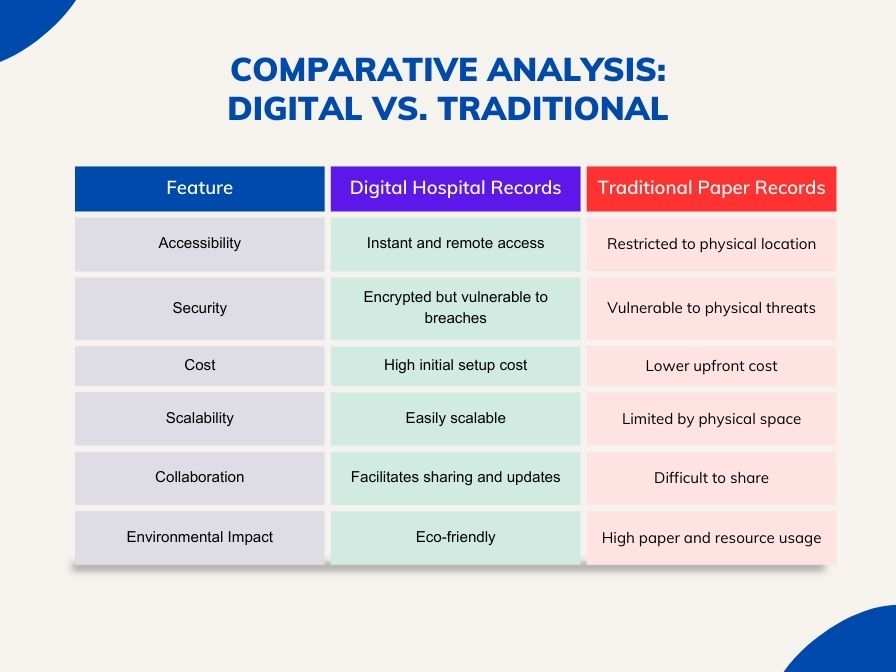
Comparative Analysis: Digital vs Traditional
Which Method Should You Use?
The choice between digital and traditional records depends on several factors, including the size of the healthcare facility, budget constraints, and long-term goals.
When to Use Digital Records
- Large hospitals or multi-specialty clinics handling high patient volumes.
- Facilities aiming to improve efficiency, collaboration, and data analysis.
- Organizations looking to comply with modern healthcare regulations.
- Institutions ready to invest in technology and staff training.
When to Use Paper Records
- Small clinics or solo practitioners with minimal patient loads.
- Facilities in rural or underserved areas with limited access to technology.
- Temporary or short-term healthcare setups where digital systems aren’t feasible.
A Hybrid Approach: The Best of Both Worlds
A hybrid approach can be the most practical solution for many healthcare providers. This involves using digital records as the primary system while maintaining paper backups for critical or sensitive documents. Hybrid systems allow for better accessibility and security while addressing concerns like downtime or technological failures.
Conclusion
In the debate between digital hospital records and traditional paper records, the scales tip in favor of digital systems due to their efficiency, accessibility, and ability to adapt to modern healthcare needs. However, the transition to EHRs has challenges that must be carefully managed.
Ultimately, the decision should align with the facility’s operational needs, budget, and patient care goals. Whether you choose a digital, traditional, or hybrid system, the priority remains the same: delivering high-quality, efficient, and secure patient care.